The Insulin Infusion Set is a vital part of the system keeping our little PWD going. And BD reckon it can be improved. I'm all ears...
 |
| BD FlowSmart Insulin Infusion Set |

Some will pass in a few hours, a shrug of shoulders, a throw away remark (family friendly or otherwise) along the lines of "Well that's T1D, ho ho". Could have been so many things...
Others will drive you potty and eventually, after sticking in multiple additional boluses, failing to find any obvious bubbles or kinks in the line, you'll change the infusion set and start again, perhaps using a pen injection to bring things back into line and make sure those pesky ketones are knocked back down... If you're like us, once it's out you'll peer at the catheter too, look for kinks (if it's Teflon). Occasionally we'll see something, most times nothing. Maybe it was just the site. Or that vial of insulin. Maybe. Maybe.
Once in a blue moon you'll get an occlusion alarm, but the pumping volumes and pressures are relatively low compared to the kind of occlusion alarms you'll hear on a syringe driver in a hospital, busy pushing many times the volumes insulin pumps deal with, usually at infusion rates often many, many times higher. Technically it'd be much harder to pick up occlusions reliably in an IIS and that's where "silent occlusions" come in i.e. interruptions to insulin delivery without any alarms.
Essentially the IIS is a bit like an expensive anti-kink garden hose pipe attached to a dripping tap. Put your thumb over the end of the hose and the water stops dripping and that's it. No hose connector pops off, no gushing water, no whining from the tap. Do the same with the tap turned full on, and the chances are you'll pop a hose connector off somewhere along the line (the garden hose equivalent of your occlusion alarm on a hospital ward :-) )
Yes, there are lots of options to choose from, which is great, allowing choice of steel / Teflon, length of catheter, angle of insertion, manual / inserter, er, insertion, and - crucially - different colours. I'm not knocking any of those - including the last one: little things can brighten a T1D day.
 |
| Medtronic Mio Infusion Set |
But in term of actually getting insulin from A (the pump) to B (the interstitial fluid) however, the options appear quite limited, mostly for good reason:
- all infusion lines (I think) are dual-walled (to help prevent kinks in the line)
- all lock on to the insulin reservoir (either using Luer-lock or propriety but very similar system)
- steel / Teflon catheter will mostly be a comfort choice
- length / angle of catheter will also be comfort and practical choice in terms of keeping in catheter tip in the tissue without causing local trauma through movement whilst being worn
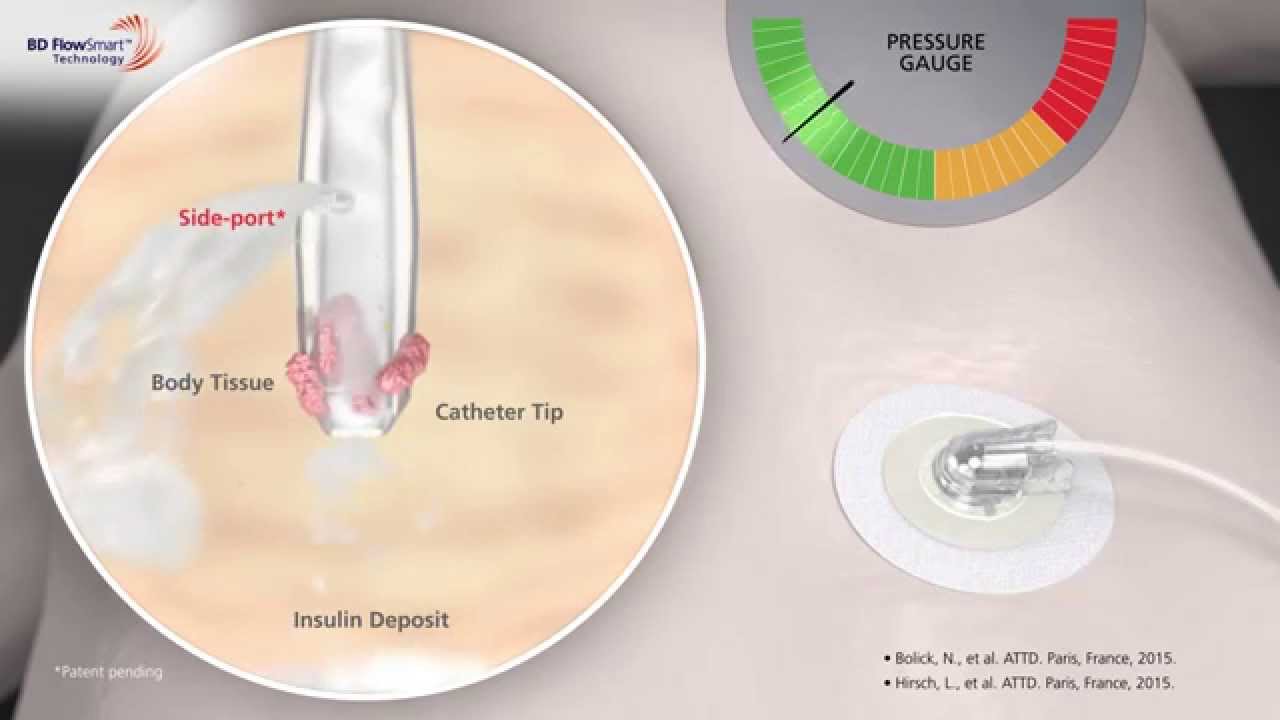
- the catheter tip (the single port) will drip insulin out to diffuse into the tissue in its immediate vicinity
Maybe the basic design (the kink-free garden hose) is so great that it doesn't need fixing? But anecdotal evidence online doesn't support that - the IIS is implicated daily in grumblings on social media and every few weeks in this T1D household. This background didn't escape the notice of Heinemann and Krinelke in their JSDT review of insulin infusion sets in 2012.
So what could be improved?
- Make insertion less painful.
- Reduce the number of flow interruptions, especially those "silent occlusions"
Enter FlowSmart - BD (Becton, Dickinson and Company) in collaboration with JDRF and the Helmsley Charitable Trust.
First, it has a tiny 30 gauge insertion needle, which should make insertion less painful, and cause less local tissue trauma. (Larger needle gauge numbers mean a narrower needle. Most IIS cannulas appear to be 25-29 G).
But most importantly it has a unique side-ported catheter:
A very crude, low-tech explanation is to think of the garden hose again with a small hole in the side of the garden hose. With the tap on and the hose trigger pulled, water will flow out the end of the hose and the soft plastic of the hose will keep the hole just about closed. Release the hose trigger (or put your thumb over the end of hose) and now, pressure will build up, the water will look for an easy way out and the tiny hole in the side of the hose will now be forced open.
I love the very cool use of MRI used to validate the side-port operating in real life [note the infusion line extensions to keep the insulin pump well away from the MRI bore and the use of a placebo (ie not insulin). Don't take your insulin pump into a MRI room!]
BD claim FlowSmart sets reduce the risk pressure events, including interrupted insulin delivery through silent occlusions, by 75% compared to the UnoMedical / Medtronic QuickSet
That sounds like a significant reduction to me and I'd love to see it added to the available IIS product line. FlowSmart gained FDA clearance in May last year and was apparently submitted to one of the EU notified bodies for CE marking around the same time, but a quick search hasn't yielded reference of it being granted. Medtronic and BD entered an agreement in June to introduce FlowSmart IIS to its pumps, with an expectation to launch this year, as the Minimed Pro-Set. BD mention FlowSmart is designed to work with most insulin pumps, regardless of manufacturer.
I love the fact that BD have gone back to the drawing board to look at one of the basic, yet important, components of the delivery system and have used some very high-tech systems to validate the new design. In a technology world focused on algorithms and apps I, for one, will definitely be talking to our DSN and hoping to order this clever piece of plastic tubing just as soon as its available.
No comments:
Post a Comment